
The Quantum Internet & Quantum Computing
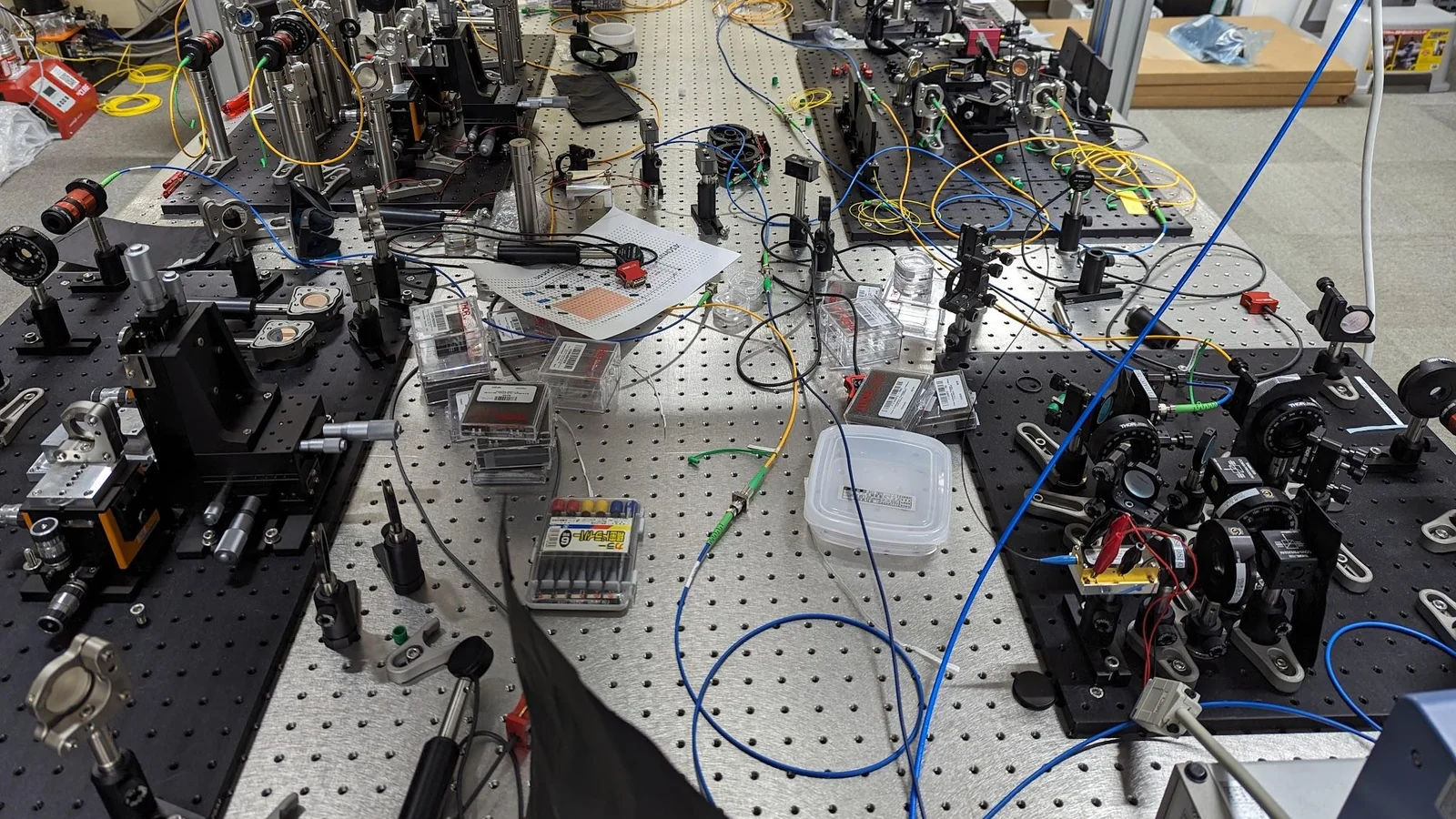
We study the mechanisms that connect individual quantum devices and allow them to operate as a network. We take a systems perspective, from physical connections and network control to application use, combining theory, simulation, and experiment. We also work on the quantum computers that such networks connect, through research on error correction and distributed quantum computing. The research is carried out in collaboration with the Quantum Internet Task Force (QITF) and as joint research with companies.
RFC 9340
The first RFC on the quantum internet
RFC 9340, “Architectural Principles for a Quantum Internet”, is the first RFC on the quantum internet. It sets out the thinking behind how a quantum internet should be designed, and was published in March 2023 by the Quantum Internet Research Group (QIRG) of the IRTF. Associate Professor Shota Nagayama is one of its authors.
The question
How can we connect distant quantum devices, coordinate them, and make them usable?
Research and methods
The numbers in the diagram match the topics below.
Building and operating networks
1Discover connections
Automatically identify a network's configuration and connection states to support device setup and operation.
2Align photon arrival times
Coordinate timing so that photons from distant nodes reach a BSA at the same time.
3Share limited resources
Let many nodes share resources such as BSAs.
4Choose and mix link architectures
Evaluate a link architecture that uses entangled photon pair sources, and networks that mix different link architectures.
Maintaining quality and supporting applications
5Estimate and improve entanglement
Estimate the fidelity of shared entanglement and raise it through purification.
6Support applications
Translate application requests into network procedures.
7Principles and architecture
Set out architectural principles in RFC 9340, the first RFC on the quantum internet, and propose an architecture for the whole network.
8Simulation and experiment automation
Develop the QuISP simulator and automate experiments.
9Examine security
Analyze attacks on the quantum internet and their effects.
Quantum computing
10Fit error-correcting codes to hardware
Run the surface code on a lattice with defective qubits, and pack logical qubits densely.
11Fault tolerance for neutral-atom computers
A scheme that keeps the surface code working on neutral-atom quantum computers as erasure errors accumulate.
12Scale up by connecting computers
Connect modular quantum computers with light and compute across them.