Quantum technology research and future society design
Q/est is one of the Real Projects of the Keio University Graduate School of Media Design (KMD). We study future societies shaped by quantum technologies and the systems that connect quantum devices. We also develop educational tools for learning quantum computing.
Meet the members For prospective students
An imagined future scene (illustration): Copying a whole molecule onto qubits
Designing Future Quantum Societies
Quantum technology could bring an industrial revolution and social transformation on the scale of semiconductors and the internet. How will science, industry, everyday life, and institutions change? Drawing on our own research and development of quantum technologies, we combine SF prototyping, dialogue, and quantitative impact analysis to describe possible futures and the conditions needed to realize them.
This work is carried out as an activity of the Quantum Future Society Design Research Center.
See fifteen future scenes in motion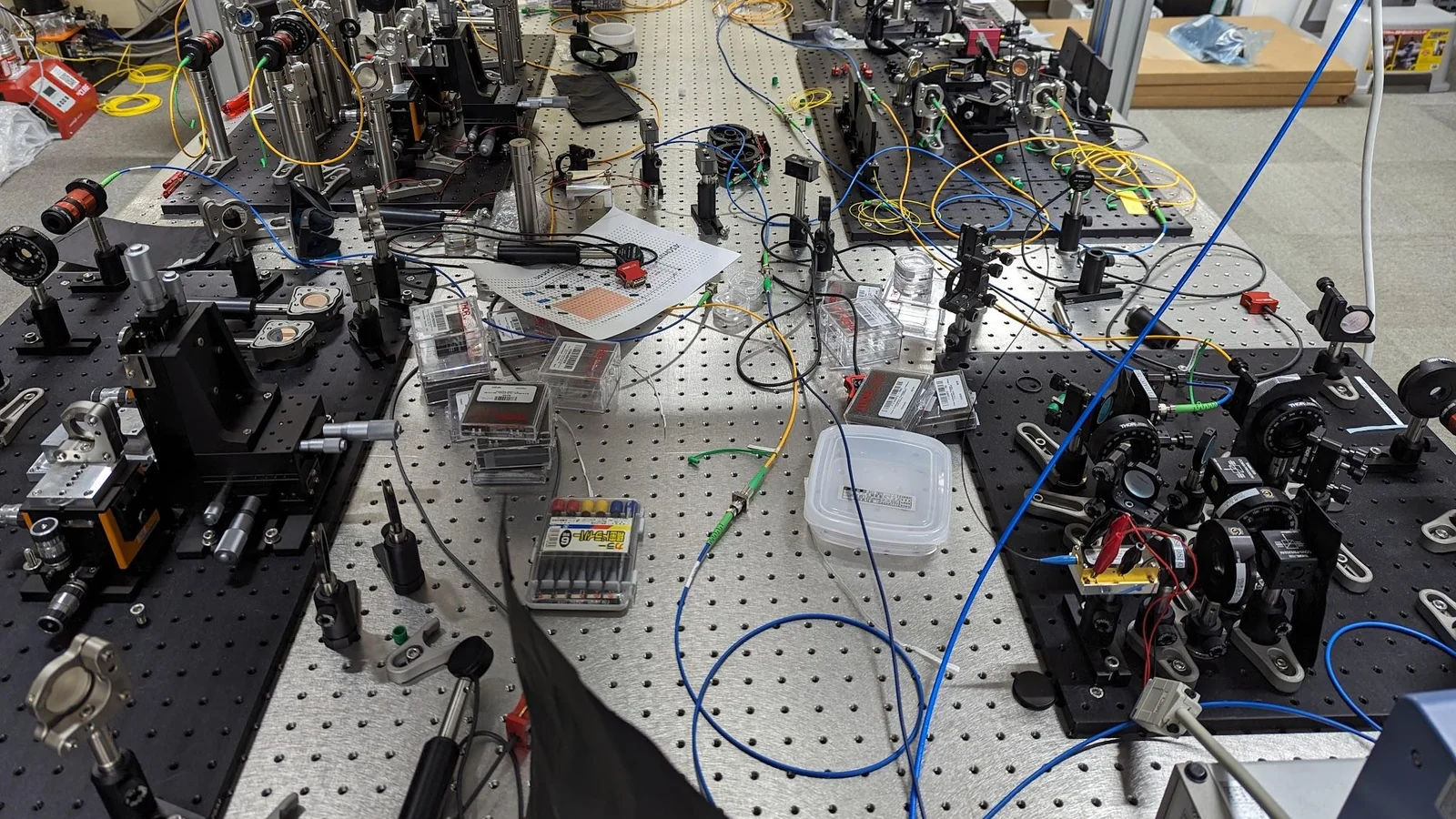
An optical table in the laboratory at Shin-Kawasaki, set up for quantum-network experiments (photograph)
The Quantum Internet & Quantum Computing
We study automatic configuration, resource sharing and control, and communication protocols to connect distant quantum devices and make networks accessible to applications. We also co-authored RFC 9340, the first RFC on the quantum internet.
We work with the Quantum Internet Task Force (QITF) and through joint research with companies.
About this researchProjects
Designing Future Quantum Societies
Quantum technology could bring an industrial revolution and social transformation on the scale of semiconductors and the internet. How will science, industry, everyday life, and institutions change? Drawing on our own research and development of quantum technologies, we combine SF prototyping, dialogue, and quantitative impact analysis to describe possible futures and the conditions needed to realize them.
The Quantum Internet & Quantum Computing
We study automatic configuration, resource sharing and control, and communication protocols to connect distant quantum devices and make networks accessible to applications. We also co-authored RFC 9340, the first RFC on the quantum internet.
Learning Quantum Computing Through Play
We create educational tools and materials that make quantum ideas easier to understand through images.
Try it
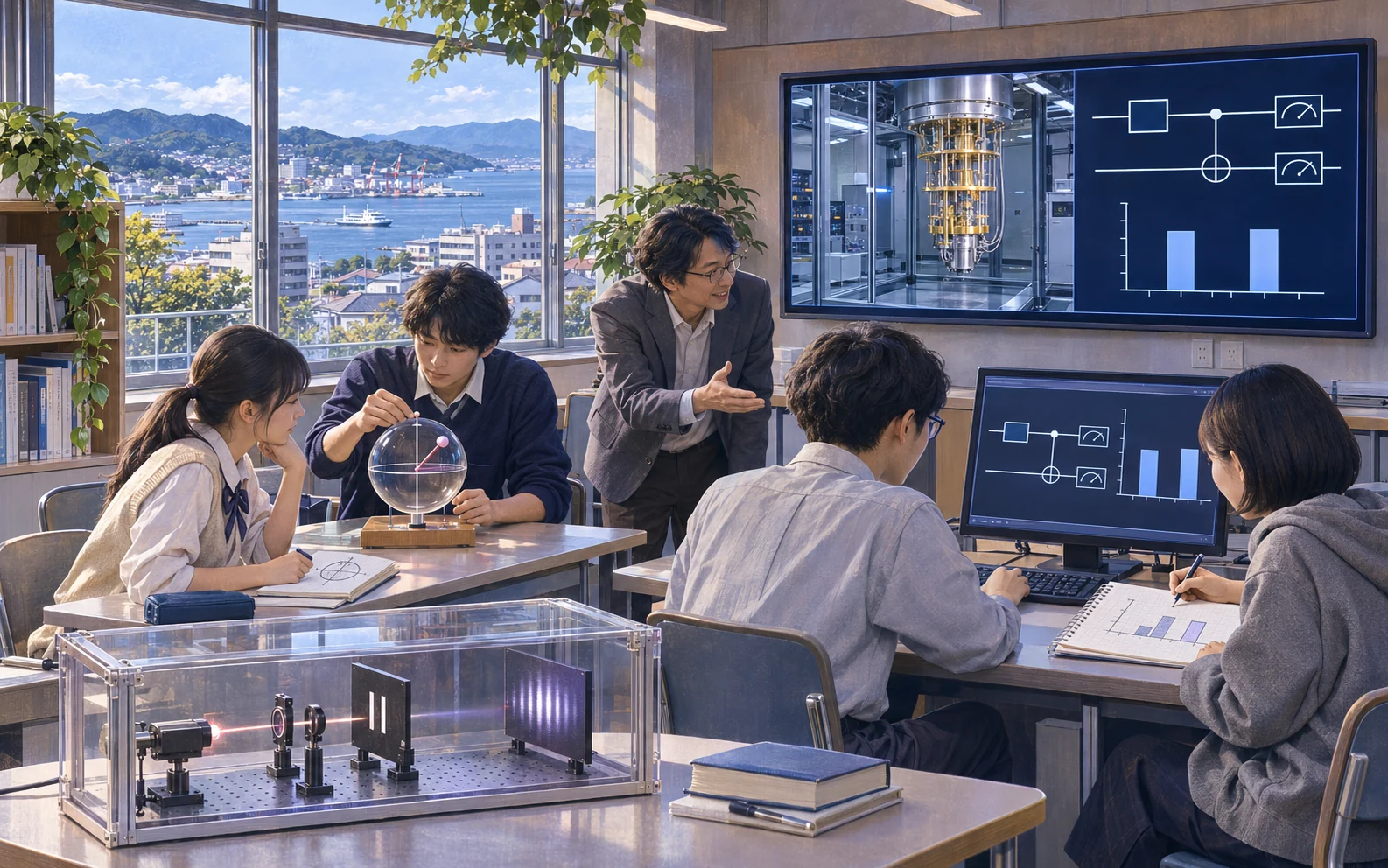
Taking part in science from a local classroom
Students test their predictions on a quantum computer from a community learning space. They change circuits and compare measurements to explore how quantum computation works.
Play with Quantum Image MixerFrom our research and activities

Automatically discovering network connections
We study protocols that automatically identify a network’s configuration and connection states when devices are connected. The paper “Automatic Configuration Protocols for Optical Quantum Networks” received the QNET Best Paper Award, 2nd place, at IEEE Quantum Week 2025.
Read the research announcement2026.04.08 / QCNC 2026
Discussing the conditions for quantum futures
The Connecting the Dots workshop brought together technical and social perspectives. Participants discussed the conditions, expectations, and concerns that could make quantum technologies meaningful in society. SF prototyping was used as a method for relating technical possibilities to changes in everyday life.
Read the workshop report