
Research: Evaluating and mixing link architectures
Papers
- An Implementation and Analysis of a Practical Quantum Link Architecture Utilizing Entangled Photon Sources
- Performance of Quantum Networks Using Heterogeneous Link Architectures
Several architectures have been proposed for the links that create entanglement between neighboring nodes of a quantum repeater network. In some, photons leave the nodes and are measured at a device in the middle; in the Memory-Source-Memory (MSM) link, an entangled photon pair source in the middle sends photons out to the nodes on both sides.
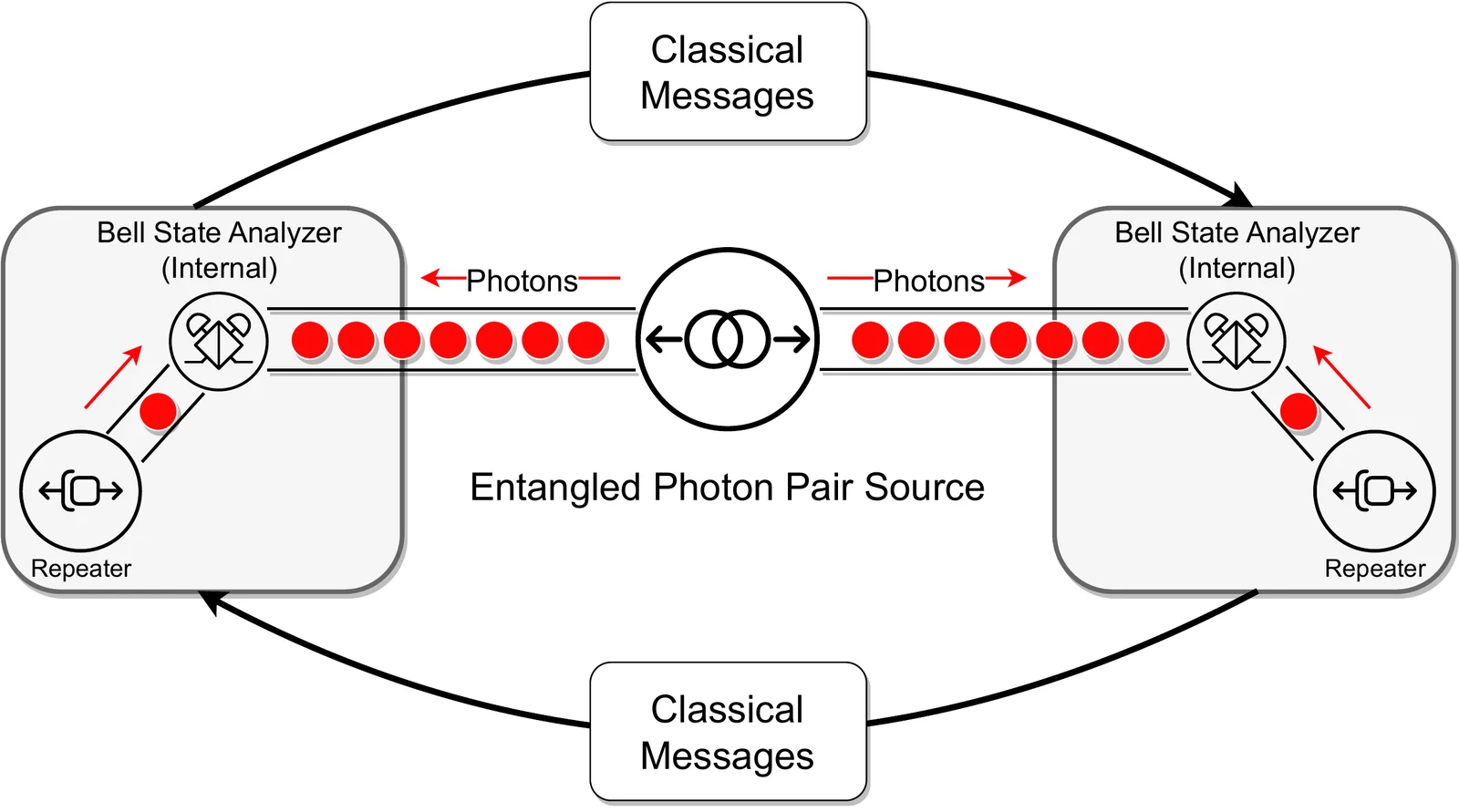
The first paper takes up the MSM link, whose practical implementation had not been worked out, and compares its performance with other link architectures using the quantum internet simulator QuISP. It finds a saturation effect, in which adding quantum resources no longer changes the Bell pair generation rate, and gives a theoretical model that explains the effect and the parameter region where it occurs.
The second paper uses QuISP to evaluate networks in which two different link architectures coexist. It first tunes the photon-pair protocol on a single link and finds that a higher pulse rate can lower overall performance. It then shows that heterogeneous networks do work: performance depends strongly on how the links are configured, but the entanglement generation rate does not drop significantly compared with homogeneous networks.
An Implementation and Analysis of a Practical Quantum Link Architecture Utilizing Entangled Photon Sources
-
Authors
Kento Samuel Soon, Michal Hajdušek, Shota Nagayama, Naphan Benchasattabuse, Kentaro Teramoto, Ryosuke Satoh, Rodney Van Meter
-
URL
https://doi.org/10.1109/QCNC62729.2024.00014
https://arxiv.org/abs/2405.09861
Performance of Quantum Networks Using Heterogeneous Link Architectures
-
Authors
Kento Samuel Soon, Naphan Benchasattabuse, Michal Hajdušek, Kentaro Teramoto, Shota Nagayama, Rodney Van Meter
-
URL
https://doi.org/10.1109/QCE60285.2024.00221
https://arxiv.org/abs/2405.09862