
Research: Estimating and improving entanglement with fewer Bell pairs
Paper: A Tailored Fidelity Estimation and Purification Method for Entangled Quantum Networks
When a quantum network is brought up, we need to know how close the entanglement shared between nodes (Bell pairs) is to the ideal, that is, its fidelity. If the fidelity is too low, it is raised by an operation called purification. Both steps consume many Bell pairs, so they determine how long bootstrapping takes.
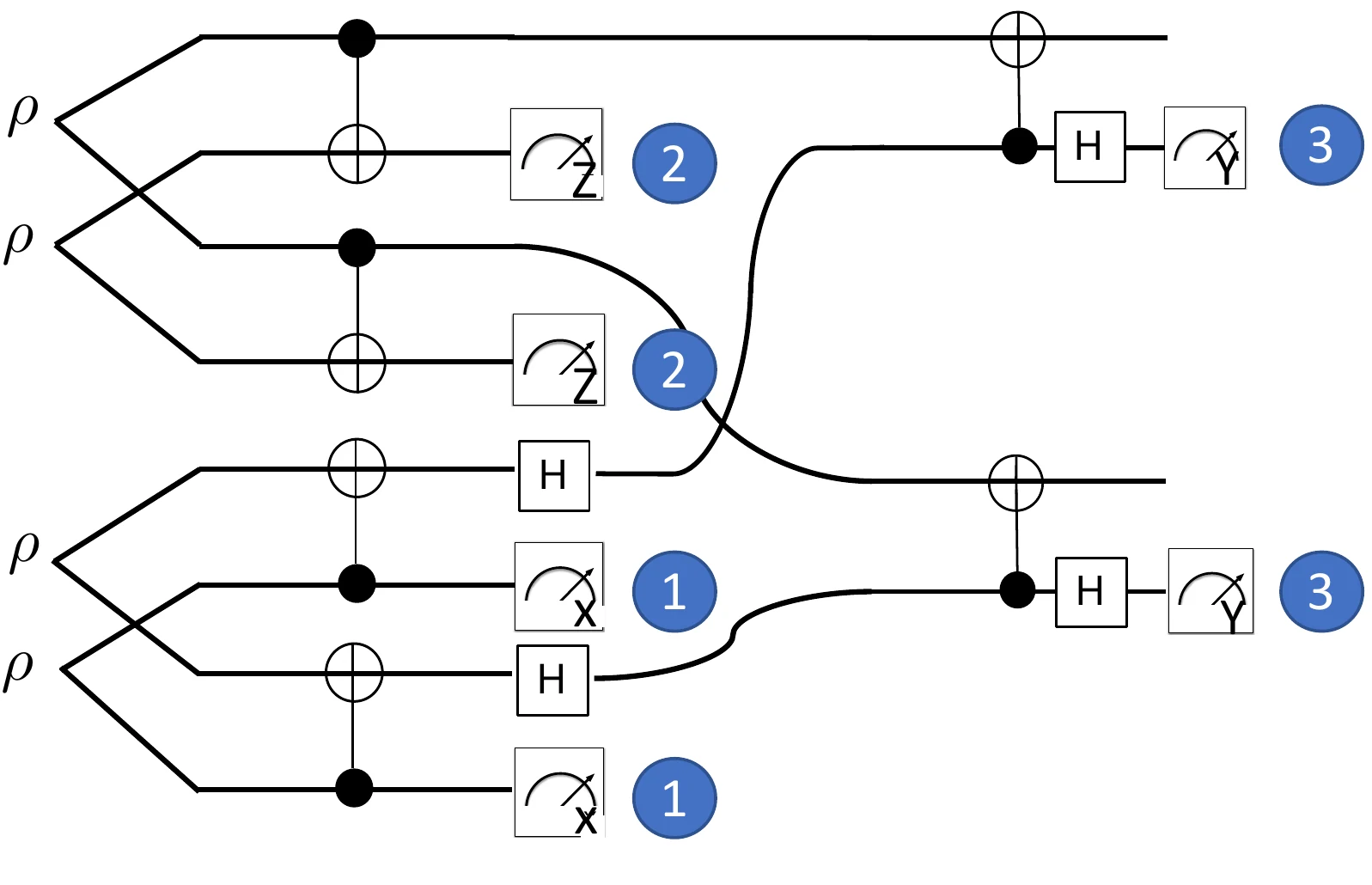
This work proposes a method that carries out quantum state reconstruction and entanglement purification at the same time. Estimating a fidelity of 0.99 within ±0.01 at 99.7% confidence takes about 2,841 Bell pairs, far fewer than the more than 100,000 an existing method needs. The method can start from lower-fidelity pairs, purify them repeatedly, and estimate the resulting fidelity with a stated confidence level. Where the earlier approach corrects only one type of error, it corrects bit-flip and phase-flip errors together.
The paper also gives numerical estimates of the number of Bell pairs needed to reach a threshold fidelity, which can be used to estimate the time needed to bootstrap a network.
-
Authors
Takafumi Oka, Michal Hajdušek, Shota Nagayama, Rodney Van Meter
-
URL