
Research: Tolerating accumulating erasures on neutral-atom quantum computers
Paper: Erasure-tolerance scheme for the surface codes on neutral atom quantum computers
Quantum computers built from neutral atoms arranged with optical tweezers are strong candidates for fault-tolerant quantum computation. One obstacle is atom loss and leakage out of the states used for computation. Leakage is known to be convertible into erasure errors, whose locations are known, but erasures keep occurring during a computation and accumulate.
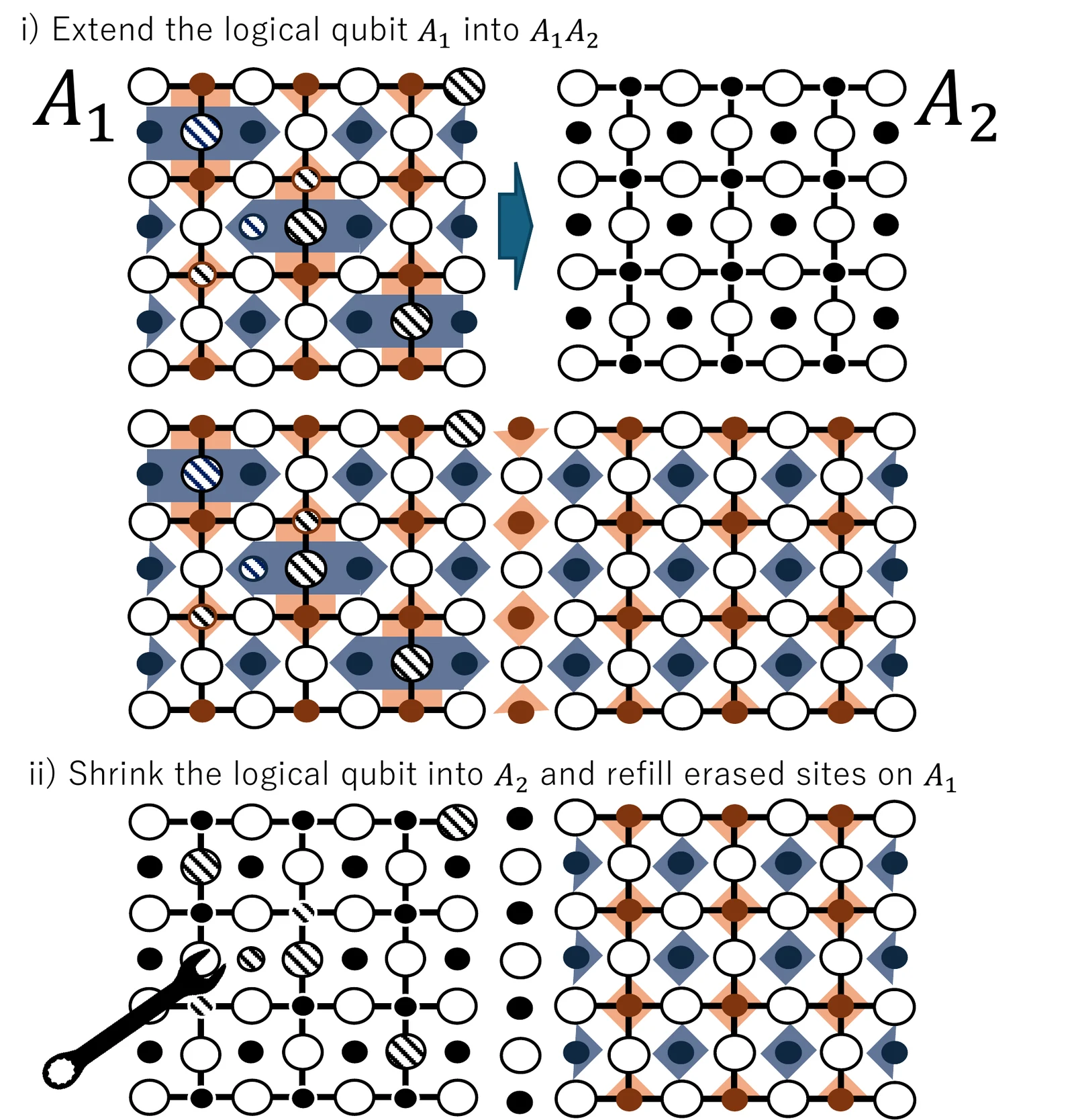
This work evaluates the effect on the surface code with circuit-level Monte Carlo simulations that include both depolarizing errors and accumulating erasures. It then proposes a scheme called k-shift erasure recovery, which uses code deformation to move a logical qubit repeatedly from an atom array in which erasures have accumulated to an array without defects.
Atoms are refilled in the area the logical qubits have been moved away from, so the optical tweezer operations used for refilling do not disturb the qubits that hold the logical data.
-
Authors
Fumiyoshi Kobayashi, Shota Nagayama
-
URL
https://doi.org/10.1109/TQE.2025.3627918
https://arxiv.org/abs/2404.12656