
Research: Q-Fly: an optical interconnect for quantum computers
Paper: Q-Fly: An Optical Interconnect for Modular Quantum Computers
Scaling up quantum computers requires an interconnect that links multiple modules with light. Unlike in classical computers, photon loss is a major constraint on quantum connections, so the design has to keep the number of hops and optical components low.
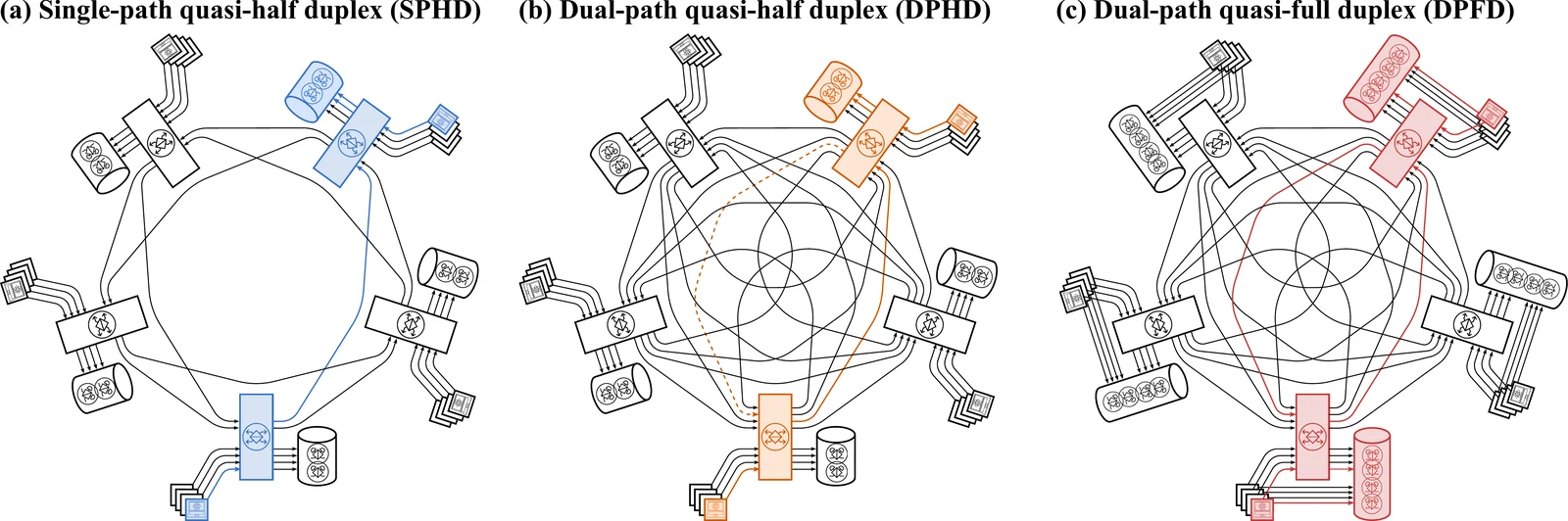
Q-Fly is an optical interconnect inspired by the classical Dragonfly network topology. Modules are divided into groups, and each group’s switch routes photons either to a shared pool of Bell State Analyzers (BSAs) or along a short path to another group. Entanglement swapping at the BSAs creates entanglement between distant modules.
The paper presents a full-stack performance analysis and an initial resource estimate for large fault-tolerant systems. A three-node prototype generated two-hop entanglement with fidelities of 0.6 to 0.76. The results show that moderate-radix switches can meet near-term needs while large systems remain feasible, and the approach is expected to apply to technologies such as ion traps and neutral atoms.
-
Authors
Daisuke Sakuma, Tomoki Tsuno, Hikaru Shimizu, Yuki Kurosawa, Monet Tokuyama Friedrich, Kentaro Teramoto, Amin Taherkhani, Andrew Todd, Yosuke Ueno, Michal Hajdušek, Rikizo Ikuta, Rodney Van Meter, Toshihiko Sasaki, Shota Nagayama
-
URL